
A Foundational Compass for Board Examination Preparation
The subject of Tarjuma-tul-Quran in the 10th class syllabus is not merely an academic requirement; it is an interpretive discipline that demands precision, conceptual clarity, and disciplined memorization. With the approach of the 2026 board examinations, students across Punjab and other affiliated boards are increasingly searching for one critical academic tool: the 10th class Tarjuma-tul-Quran pairing scheme 2026.
This article serves as an exhaustive, student-centric guide that unpacks the pairing scheme in a lucid yet scholarly manner. It is written to assist candidates, educators, and academies who wish to align preparation with the examiner’s mindset rather than relying on conjecture.
Understanding the Tarjuma-tul-Quran Pairing Scheme
What the Pairing Scheme Actually Represents
The pairing scheme is not a casual outline. It is an officially structured blueprint that reveals how Quranic verses (Ayat) are grouped together for examination purposes. These pairings determine:
- Which Surahs or Ayat appear together
- How translation questions are distributed
- The balance between short and long answers
In essence, the scheme functions like a cartographic chart, guiding students through the terrain of the paper before they ever step into the examination hall.
Why the 2026 Pairing Scheme Holds Exceptional Importance
A Shift Toward Analytical Preparation
Recent examination trends indicate a gradual move away from random question distribution. Boards now emphasize structured assessment, where predictability exists for those who study intelligently.
The 10th class Tarjuma-tul-Quran pairing scheme 2026 helps students:
- Eliminate irrelevant portions
- Prioritize high-yield Ayat
- Allocate time proportionately
- Reduce cognitive overload
Instead of rote repetition, the scheme encourages selective mastery, which is both efficient and intellectually sustainable.
Paper Pattern Overview for Tarjuma-tul-Quran (Class 10)
Structural Anatomy of the Question Paper
Although minor variations may occur, the paper generally adheres to the following architecture:
- Objective Section
Short MCQs derived from selected Ayat meanings and key vocabulary. - Short Answer Section
Brief translation-based or concept-oriented questions, often linked to paired verses. - Long Answer Section
Detailed translation and explanation questions where the pairing scheme becomes decisive.
Understanding this skeletal framework allows students to see how the pairing scheme is woven into every segment of the paper.
Detailed Breakdown of the Pairing Scheme 2026
Surah-Wise Distribution
The pairing scheme categorizes the syllabus Surah by Surah, ensuring that verses from the same thematic stream are assessed together. This method preserves contextual integrity and discourages fragmented learning.
Typically, the scheme includes:
- Logical verse pairings
- Balanced difficulty levels
- Recurrent examination favorites
Students who internalize these pairings often experience a striking improvement in retention and recall.
Strategic Advantages of Studying Through the Pairing Scheme
Precision Over Volume
Many students fall into the trap of studying everything with equal intensity. The pairing scheme rescues learners from this inefficiency.
Key advantages include:
- Focused memorization of paired Ayat
- Reduced syllabus anxiety
- Enhanced translation fluency
- Better answer structuring
In practical terms, the scheme transforms preparation from exhaustive to surgical.
How Teachers and Academies Use the Pairing Scheme
A Pedagogical Backbone
Seasoned teachers rarely teach Tarjuma-tul-Quran without reference to the pairing scheme. Academies structure:
- Test papers
- Revision schedules
- Weekly assessments
around it. For private candidates, adopting the same approach levels the academic playing field.
Common Misconceptions About Pairing Schemes
Myth vs Reality
Myth: Pairing schemes guarantee exact questions.
Reality: They indicate probable combinations, not verbatim repetition.
Myth: Only weak students need pairing schemes.
Reality: Toppers rely on them to refine already strong preparation.
Understanding these distinctions prevents misplaced expectations and encourages realistic academic planning.
How to Prepare Tarjuma-tul-Quran Using the 2026 Pairing Scheme
Step-by-Step Methodology
- Obtain the Authentic Scheme
Ensure the scheme aligns with the latest board notifications. - Mark Paired Ayat in the Textbook
Visual cues reinforce memory. - Practice Translation in Pairs
Translate Ayat together rather than in isolation. - Write Past Paper Answers Accordingly
This conditions the mind to respond in examination style. - Revise Selectively, Not Randomly
Revisit high-frequency pairings more often.
This method instills confidence while minimizing unnecessary academic strain.
Linguistic Depth in Tarjuma-tul-Quran Preparation
Beyond Literal Translation
Board examiners increasingly appreciate translations that reflect conceptual fidelity, not mechanical word substitution. The pairing scheme supports this by grouping verses with shared moral or theological undertones.
Students should aim for:
- Semantic clarity
- Contextual coherence
- Consistent terminology
Such depth differentiates average scripts from exceptional ones.
Downloading the 10th Class Tarjuma-tul-Quran Pairing Scheme 2026
Accessing the Resource Safely
When downloading the pairing scheme, always ensure that:
- The source is educationally credible
- The scheme mentions the year 2026 explicitly
- It corresponds to your relevant board
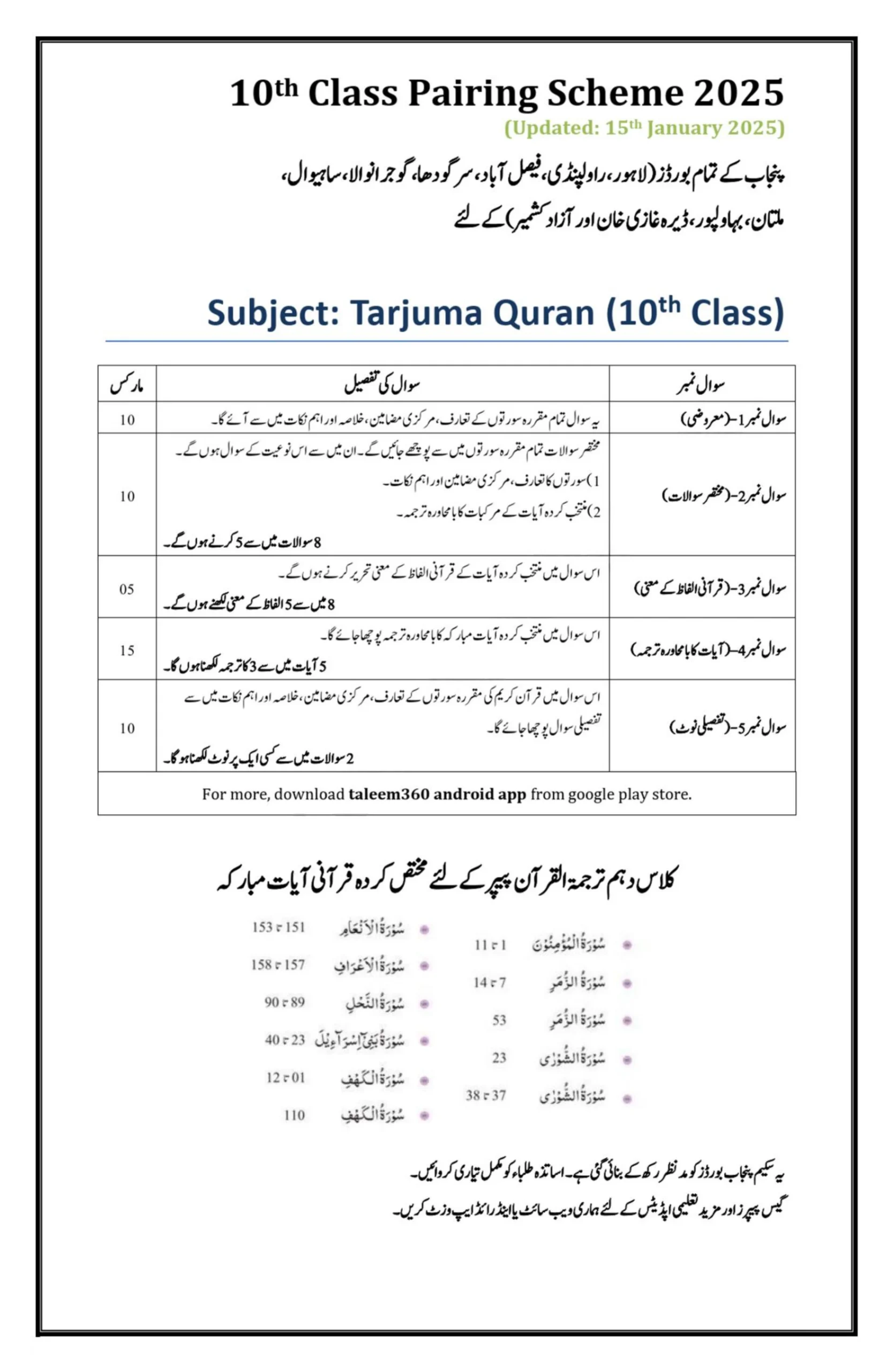
10th Class Tarjuma-tul-Quran Pairing Scheme 2026 – Complete Guide for Board Exams
Meta Title (SEO – 60 characters max)
10th Class Tarjuma-tul-Quran Pairing Scheme 2026
Meta Description (155–160 characters)
Download and understand the 10th class Tarjuma-tul-Quran pairing scheme 2026. Complete paper pattern, preparation tips, FAQs, and exam strategy.
Introduction: Why the Pairing Scheme Matters in 2026
The 10th Class Tarjuma-tul-Quran Pairing Scheme 2026 has become one of the most searched academic resources among matric students preparing for board examinations. Every year, thousands of students struggle not because the syllabus is difficult, but because they lack direction. This pairing scheme provides that direction. It clarifies how Quranic verses are grouped, how questions are structured, and how marks are distributed—allowing students to prepare with precision instead of guesswork.
For students aiming to score high while reducing unnecessary workload, understanding the pairing scheme is not optional. It is essential.
What Is the 10th Class Tarjuma-tul-Quran Pairing Scheme 2026?
The pairing scheme is an official academic framework released (or followed) by education boards to outline how chapters and verses will be combined in the examination paper.
In Tarjuma-tul-Quran, this scheme explains:
- Which Surahs and Ayat will be paired together
- How translation questions will appear
- The structure of short and long questions
- The balance between compulsory and optional questions
Instead of studying the entire syllabus randomly, students can focus on strategically important verse combinations.
Why the Tarjuma-tul-Quran Pairing Scheme 2026 Is Crucial
1. Smart Study Approach
The pairing scheme eliminates confusion. Students know exactly which verses are likely to appear together, making revision faster and more effective.
2. Time Management
With limited preparation time, focusing on paired verses prevents over-preparation and burnout.
3. Higher Scoring Potential
Board examiners follow structured patterns. Students aligned with the pairing scheme naturally score better.
4. Reduced Exam Stress
Confidence increases when students walk into the exam hall knowing what to expect.
Updated Paper Pattern for Tarjuma-tul-Quran (Class 10 – 2026)
Understanding the paper pattern alongside the pairing scheme gives a complete picture of the exam.
Objective Section (MCQs)
- Short, concept-based questions
- Vocabulary meanings from selected Ayat
- Repeated themes from pairing scheme verses
Short Questions Section
- Brief translation or explanation
- Usually derived from paired Surahs
- Focus on meanings and message
Long Questions Section
- Detailed translation of Ayat
- Explanation of Quranic teachings
- Pairing scheme plays a major role here
Surah-Wise Pairing Structure Explained
The 10th Class Tarjuma-tul-Quran Pairing Scheme 2026 follows a logical Surah-based structure. Verses sharing similar themes—such as faith, morality, social justice, or obedience—are grouped together.
This structure helps students:
- Understand Quranic context
- Memorize meanings more naturally
- Write coherent answers in exams
How to Prepare Using the Pairing Scheme (Step-by-Step)
Step 1: Get the Authentic Pairing Scheme
Always use the latest scheme relevant to 2026 and your specific board.
Step 2: Mark Paired Ayat in the Textbook
Highlight paired verses using colors or notes.
Step 3: Learn Translation in Pairs
Study Ayat together rather than individually. This improves retention.
Step 4: Practice Writing Answers
Write translations and explanations exactly as required in exams.
Step 5: Revise High-Frequency Pairings
Some verse combinations are repeatedly tested—prioritize them.
Beginner to Advanced Study Strategy
For Beginners
- Start with basic word meanings
- Understand the message of each Ayat
- Use simple English translations
For Intermediate Students
- Focus on paired Surahs
- Practice short questions daily
- Compare translations for clarity
For Advanced Students
- Master long questions
- Improve presentation and handwriting
- Use Islamic terminology accurately
Common Mistakes Students Make
- Ignoring the pairing scheme completely
- Memorizing translations without understanding meaning
- Studying randomly without prioritization
- Overlooking repeated exam trends
Avoiding these mistakes can significantly improve results.
Comparison: Studying With vs Without Pairing Scheme
| Aspect | Without Pairing Scheme | With Pairing Scheme |
|---|---|---|
| Study Direction | Confused | Clear and focused |
| Time Usage | Inefficient | Optimized |
| Stress Level | High | Low |
| Exam Confidence | Weak | Strong |
| Scoring Potential | Average | High |
Important Topics Frequently Asked in Exams
Based on past papers and pairing trends, examiners often focus on:
- Moral teachings of Quran
- Rights and responsibilities
- Social justice and honesty
- Obedience to Allah and His Messenger
These themes often appear within paired Ayat.
Image Optimization (For Blog SEO)
When publishing this article, use images such as:
- Tarjuma-tul-Quran textbook cover
- Sample pairing scheme charts
- Study planning visuals
Suggested Image Alt Texts:
- “10th Class Tarjuma-tul-Quran Pairing Scheme 2026 PDF”
- “Tarjuma-tul-Quran class 10 paper pattern 2026”
- “Paired Surahs for Tarjuma-tul-Quran matric”
People Also Ask (Answered)
Is the pairing scheme officially confirmed for 2026?
The structure follows official board patterns. Minor changes may occur, but the core framework remains consistent.
Can pairing schemes guarantee exact questions?
No, but they significantly increase prediction accuracy.
Is the pairing scheme useful for private candidates?
Yes, especially for private students with limited guidance.
Should I skip unpaired chapters?
No. Study everything, but prioritize paired sections.
Frequently Asked Questions (FAQs)
What is the 10th Class Tarjuma-tul-Quran Pairing Scheme 2026?
It is a structured outline showing how Quranic verses are grouped for examination purposes.
Where can I download the pairing scheme?
From educational websites, academies, or trusted teacher platforms.
Does every board follow the same pairing scheme?
Mostly yes, with slight variations.
How many times should I revise paired Ayat?
At least three complete revisions before exams.
Is translation memorization enough to score well?
No. Understanding meaning and context is equally important.