
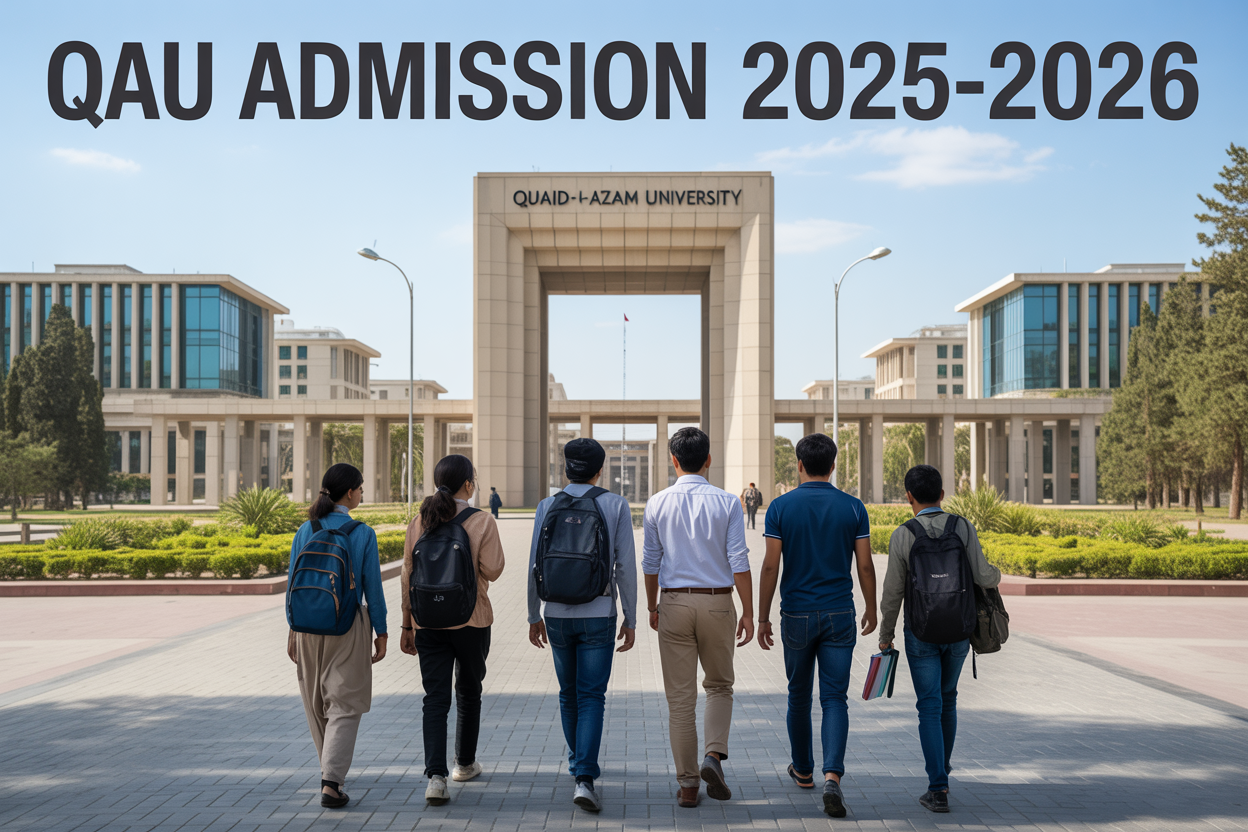
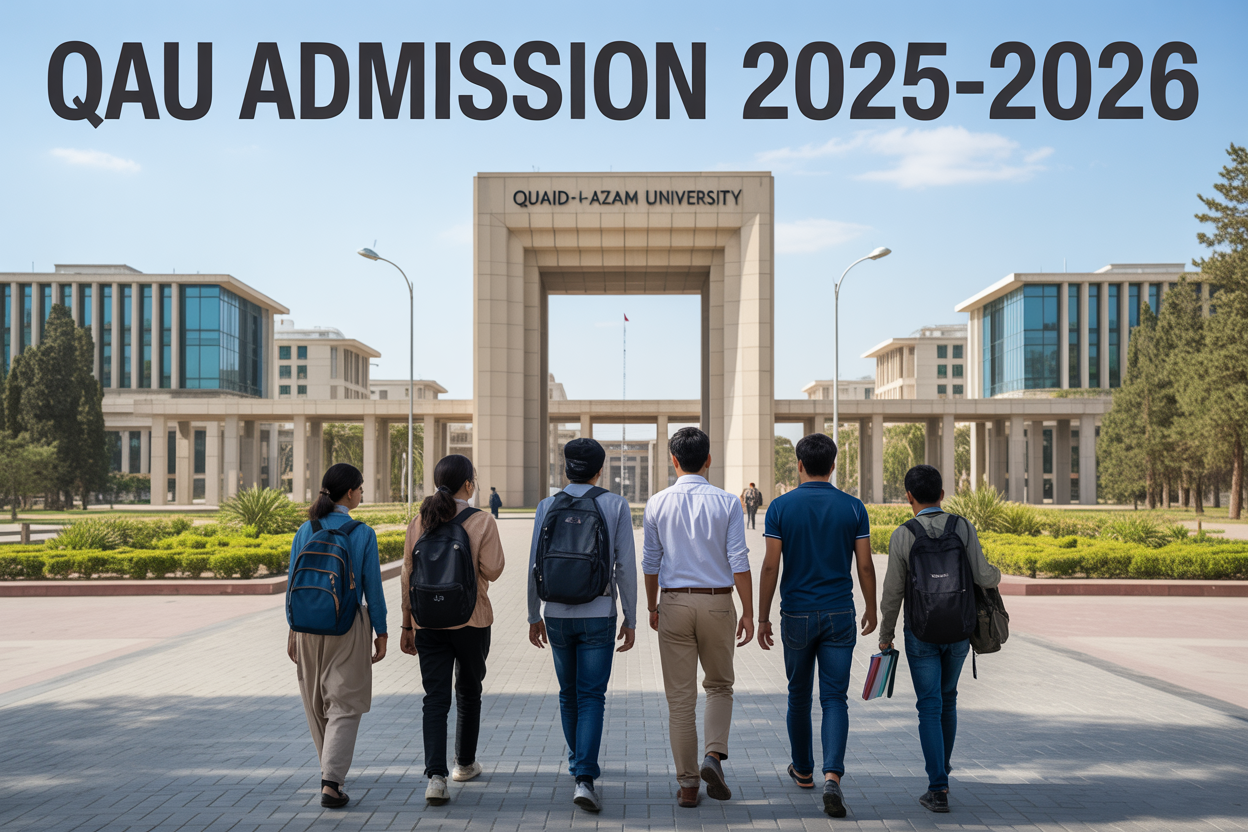
Getting into Quaid-i-Azam University for the 2025-2026 academic year requires knowing the right steps and meeting specific requirements. This guide is designed for high school graduates, transfer students, and anyone planning to apply to one of Pakistan’s top universities.Quaid‑i‑Azam University Admission 2025-2026.
We’ll walk you through the complete admission requirements and eligibility criteria so you know exactly what QAU expects from applicants. You’ll also get a clear breakdown of the application process and key deadlines you can’t afford to miss. Plus, we’ll cover the admission test format and share practical preparation tips to help you perform your best on exam day.
Admission Requirements and Eligibility Criteria

Academic Qualifications for Undergraduate Programs
Quaid-i-Azam University sets clear academic standards for undergraduate admission. Students need a minimum of 45% marks in their intermediate or equivalent examination from a recognized board. The university accepts FSc (Pre-Medical/Pre-Engineering), FA (Faculty of Arts), ICS (Intermediate in Computer Science), and I.Com (Intermediate in Commerce) certificates.
For engineering programs, students must have studied Physics, Chemistry, and Mathematics at intermediate level. Medical programs require Physics, Chemistry, and Biology. Business and social science programs welcome students from all academic backgrounds, though specific subjects may be preferred for certain specializations.
International qualifications like A-Levels require at least three subjects with minimum C grades. Students with O-Levels need five subjects including English, Mathematics, and relevant sciences. The university’s equivalence committee evaluates foreign certificates to ensure they meet Pakistani standards.
Graduate Program Prerequisites and Degree Requirements
Master’s degree programs require a bachelor’s degree with a minimum 2.5 CGPA or 45% marks from an HEC-recognized institution. The degree must be in a relevant field – for example, MBA applicants need a business-related undergraduate degree, while MS Computer Science requires a computing background.
PhD programs demand a master’s degree with at least 3.0 CGPA or 60% marks. Research experience, publications, and a strong academic record significantly boost admission chances. Some departments conduct additional interviews or require research proposals.
Professional programs like LLM require an LLB degree from a recognized law school. Medical specializations need an MBBS degree and completion of a house job. Each graduate program has specific prerequisites, so checking individual department requirements is essential.
International Student Admission Standards
International students must provide equivalent qualifications recognized by HEC Pakistan. Academic transcripts need authentication from the issuing country’s education ministry or Pakistani consulate. Students from non-English speaking countries must demonstrate English proficiency through IELTS (minimum 6.0) or TOEFL (minimum 79 iBT).
The university requires a student visa and proof of financial support covering tuition fees and living expenses. International students pay higher fees compared to Pakistani nationals. Academic credentials undergo thorough verification, which can take 4-6 weeks.
Students from SAARC countries receive preference in certain programs. The International Office provides guidance throughout the application process and helps with accommodation arrangements.
Age Limits and Citizenship Requirements
Pakistani citizens and Overseas Pakistanis can apply for all programs without age restrictions for undergraduate studies. However, some professional programs may have upper age limits – medical programs typically prefer younger candidates.
Foreign nationals compete for a 5% quota in most programs. They must provide valid passports and meet visa requirements. Dual nationals can choose to apply under either Pakistani or foreign quotas, but not both.
Age flexibility exists for graduate programs, welcoming working professionals and career changers. The university values diverse experiences and doesn’t discriminate based on age for master’s and PhD programs. Military personnel and their dependents receive special consideration under designated quotas.
Application Process and Important Deadlines

Online Application Portal Registration Steps
Creating your account on QAU’s official admission portal starts with visiting the university’s website and clicking on the “Apply Online” button. You’ll need to provide a valid email address and create a strong password that meets their security requirements. The system will send a verification email to confirm your account – check your spam folder if you don’t see it within a few minutes.
Once verified, complete your personal profile by entering basic information like your name, CNIC number, date of birth, and contact details. Make sure all information matches your official documents exactly, as any discrepancies can cause delays in processing. The portal allows you to save your progress and return later, so you don’t need to complete everything in one sitting.
After setting up your profile, select your preferred program and campus location. The system will automatically show you the specific requirements for your chosen field of study. You can apply for up to three programs in order of preference, which increases your chances of admission.
Required Documents and Submission Guidelines
The document checklist varies depending on your academic level and chosen program. For undergraduate admissions, you’ll need scanned copies of your matriculation and intermediate certificates, along with detailed mark sheets. Graduate program applicants must submit their bachelor’s degree and transcripts from all previously attended institutions.
All documents must be uploaded in PDF format with a maximum file size of 2MB each. The university requires documents to be clear and readable – blurry or poorly scanned files will be rejected. Keep original documents ready for verification if you’re selected for admission.
Additional requirements include:
- Recent passport-size photographs with white background
- Copy of CNIC or Form-B
- Character certificate from your last institution
- Medical fitness certificate (for specific programs)
- Work experience certificates (for professional programs)
International students need additional documentation including passport copies, visa status, and equivalence certificates from the Higher Education Commission of Pakistan.
Application Fee Payment Methods and Amounts
QAU accepts application fees through multiple convenient payment methods. The standard application fee is PKR 2,000 for most undergraduate programs, while graduate programs charge PKR 3,000. PhD applicants pay PKR 4,000 as their application fee.
Payment options include:
- Online banking through HBL, UBL, MCB, and other major banks
- Credit and debit card payments (Visa, MasterCard accepted)
- Mobile wallet services like JazzCash and EasyPaisa
- Bank challan deposit at designated branches
After successful payment, save your transaction receipt and reference number. The portal typically updates payment status within 24-48 hours, but bank transfers may take longer during peak application periods. Keep checking your application status to ensure payment confirmation.
Fee waivers are available for students from economically disadvantaged backgrounds who can provide proof of financial need through relevant documentation.
Key Dates for Admission Cycles and Deadlines
QAU operates on a semester-based academic calendar with two main admission cycles each year. The Spring semester applications typically open in October and close by December, while Fall semester applications run from May through July.
Fall Semester 2025 Timeline:
- Application period: May 15 – July 20, 2025
- Admission test dates: August 5-10, 2025
- Merit list announcement: August 25, 2025
- Fee submission deadline: September 10, 2025
- Classes begin: September 20, 2025
Spring Semester 2026 Timeline:
- Application period: October 15 – December 20, 2025
- Admission test dates: January 8-12, 2026
- Merit list announcement: January 25, 2026
- Fee submission deadline: February 10, 2026
- Classes begin: February 20, 2026
These dates can shift slightly based on university calendar adjustments, so regularly check the official website for updates. Late applications aren’t accepted under normal circumstances, though emergency extensions may be granted in exceptional cases with proper justification and approval from the admissions committee.
Available Academic Programs and Departments

Undergraduate Degree Programs Across Faculties
Quaid-i-Azam University offers an impressive range of undergraduate programs spread across multiple faculties, giving students plenty of options to pursue their academic interests. The Faculty of Natural Sciences leads with popular programs like BS Physics, Chemistry, Mathematics, and Statistics. Students interested in biological sciences can choose from BS Botany, Zoology, Biochemistry, and Biotechnology programs.
The Faculty of Social Sciences provides excellent opportunities through BS programs in Economics, Psychology, International Relations, and Mass Communication. These programs are designed to develop critical thinking skills and prepare students for careers in government, media, and international organizations.
For those drawn to languages and literature, the Faculty of Arts offers BS programs in English, Urdu, Arabic, and Persian. The Economics department stands out as one of the most sought-after programs, attracting students from across Pakistan who want to build careers in banking, finance, and economic research.
The university also offers specialized undergraduate programs in Environmental Sciences, which combines multiple disciplines to address modern environmental challenges. Each program typically spans four years and includes both theoretical coursework and practical laboratory sessions. Students benefit from small class sizes that allow for personalized attention from faculty members who are experts in their respective fields.
Master’s and PhD Research Opportunities
Graduate education at QAU represents the pinnacle of academic excellence in Pakistan. The university offers Master’s programs across all major disciplines, with most programs requiring two years of intensive study. Popular Master’s programs include MS/M.Phil in Physics, Chemistry, Mathematics, Economics, and International Relations.
PhD programs are available in virtually every department, with research supervision provided by faculty members who have earned their degrees from top international universities. The university maintains strong research collaborations with institutions in the United States, Europe, and other parts of Asia, giving PhD students access to cutting-edge research opportunities.
Research areas span from theoretical physics and pure mathematics to applied economics and environmental policy. The Department of Economics, for example, conducts research on poverty reduction, economic development, and monetary policy that directly influences government decision-making. Similarly, the natural sciences departments engage in research projects funded by international organizations and government agencies.
Graduate students receive financial support through research assistantships, teaching positions, and scholarships. Many PhD students get opportunities to present their research at international conferences and publish in peer-reviewed journals. The university’s research output has grown significantly over the past decade, with faculty and students contributing to major scientific discoveries and policy recommendations.
Professional and Certificate Courses Offered
Beyond traditional degree programs, QAU provides various professional development opportunities through specialized certificate courses and short-term training programs. The Centre for Entrepreneurship offers courses in business development, startup management, and innovation that help students develop practical business skills alongside their academic studies.
Language courses are particularly popular, with programs in Chinese, German, French, and Japanese available to students from all departments. These courses help students prepare for international opportunities and enhance their global competitiveness.
The university’s IT center provides certificate courses in programming languages, data analysis, and digital marketing. These skills-based programs respond to market demands and help graduates stand out in competitive job markets. Professional development workshops cover topics like project management, leadership skills, and communication techniques.
Summer schools and intensive courses bring together students from different universities, creating networking opportunities and exposing QAU students to diverse perspectives. Many of these programs include industry partnerships, giving students direct exposure to potential employers and real-world applications of their academic learning. The flexible scheduling of these courses allows students to enhance their qualifications without disrupting their regular academic progress.
Admission Test Details and Preparation Guide

Test formats and subject areas covered
QAU administers different entrance examinations depending on your chosen program. The university uses computer-based testing for most undergraduate programs, while graduate programs may require subject-specific tests or interviews.
For undergraduate admissions, you’ll face multiple-choice questions covering:
- English Language: Grammar, vocabulary, comprehension, and basic writing skills
- Mathematics: Algebra, geometry, trigonometry, and calculus basics
- General Knowledge: Current affairs, Pakistan studies, and Islamic studies
- Analytical Reasoning: Logical thinking, problem-solving, and pattern recognition
Graduate programs have specialized tests based on departments:
| Program Type | Test Components | Duration |
|---|---|---|
| MS/PhD Sciences | Subject-specific + English + Research Aptitude | 3 hours |
| MBA | Management concepts + Quantitative skills + English | 2.5 hours |
| MA/MSc Arts | Subject knowledge + English + Critical thinking | 2.5 hours |
The scoring system follows a standardized format where each correct answer earns one mark, and there’s no negative marking for wrong answers.
Registration process for entrance examinations
Registration opens through QAU’s official portal approximately two months before test dates. Create your account using a valid email address and mobile number, as the university sends important updates through these channels.
Required documents for registration include:
- High-resolution photograph (passport size)
- Valid CNIC or Form-B
- Academic transcripts and certificates
- Domicile certificate (if applying for reserved seats)
Pay the examination fee through designated bank branches or online payment methods. Keep your challan receipt safe, as you’ll need it during the test. After successful registration, download your roll number slip, which contains your test center location and timing details.
Double-check all entered information before final submission, as changes aren’t possible after the deadline. Late registrations aren’t accepted under any circumstances.
Preparation resources and study materials
QAU provides official sample papers and previous years’ question papers on their website. These materials give you the best idea of question patterns and difficulty levels. Download these resources early in your preparation phase.
Recommended preparation strategies include:
For Undergraduate Tests:
- Practice English comprehension daily through newspapers and magazines
- Solve mathematics problems from intermediate-level textbooks
- Stay updated with current affairs through reliable news sources
- Take online mock tests to improve time management
For Graduate Tests:
- Review your undergraduate coursework thoroughly
- Focus on research methodology concepts for PhD applicants
- Practice subject-specific problems regularly
- Join study groups with fellow applicants
Popular preparation books available in local markets include NTS guides, Caravan test preparation series, and subject-specific reference materials. Many students also benefit from online preparation courses offered by various educational platforms.
Create a study schedule at least three months before your test date. Regular practice sessions work better than cramming everything at the last minute.
Test centers and scheduling options
QAU operates multiple test centers across major cities to accommodate candidates from different regions. Primary centers include:
- Islamabad: Main campus and affiliated centers
- Lahore: Designated examination halls
- Karachi: Partner institutions
- Peshawar: Regional testing facility
- Quetta: Local examination center
Test scheduling typically offers morning and afternoon sessions. Morning slots usually start at 9 AM, while afternoon sessions begin around 2 PM. The university assigns your preferred time slot based on availability and registration sequence.
Center allocation considers your residential address mentioned during registration. However, you can request a different center if you have valid reasons, such as temporary relocation or accessibility needs.
Arrive at your designated center at least 30 minutes before the scheduled time. Bring your original CNIC, roll number slip, and any other documents specified in your admission instructions. Mobile phones and electronic devices aren’t allowed inside examination halls.
Special arrangements exist for candidates with disabilities. Contact the admissions office well in advance to discuss your requirements and ensure proper accommodations at your test center.
Fee Structure and Financial Assistance Options

Tuition Fees for Different Program Categories
Quaid-i-Azam University offers competitive fee structures across various academic disciplines. Undergraduate programs typically range from PKR 15,000 to PKR 25,000 per semester, depending on the department and specialization. Arts and social sciences programs generally fall on the lower end of this spectrum, while science and technology programs command higher fees due to laboratory and equipment costs.
Graduate programs follow a tiered pricing model. Master’s degree programs cost between PKR 20,000 to PKR 35,000 per semester. PhD programs maintain similar fee ranges, though research-intensive fields like biotechnology and computer science may charge additional laboratory fees. International students face higher tuition rates, typically 3-4 times the domestic student fees, reflecting the university’s need to maintain quality education standards while remaining accessible to local students.
Professional programs such as MBA and specialized certificates carry premium pricing, ranging from PKR 40,000 to PKR 60,000 per semester. These programs often include additional resources like case studies, industry collaborations, and enhanced faculty-student ratios that justify the higher investment.
Additional Charges and Hostel Accommodation Costs
Beyond tuition fees, students should budget for several mandatory charges. The university imposes a one-time admission fee of PKR 5,000, plus annual charges for library access (PKR 2,000), sports facilities (PKR 1,500), and student services (PKR 1,000). Laboratory-intensive courses require additional fees ranging from PKR 3,000 to PKR 8,000 per semester, covering equipment usage, materials, and maintenance.
Hostel accommodation presents affordable options for out-of-town students. Single rooms cost approximately PKR 8,000 per month, while shared accommodations run PKR 4,500-6,000 monthly. These rates include basic utilities like electricity and water, though internet and cable services incur separate charges. Hostel security deposits typically equal one month’s rent, refundable upon checkout with room condition approval.
Meal plans aren’t mandatory, but the university cafeteria offers reasonable dining options. Students can expect monthly food expenses between PKR 8,000-12,000 depending on dietary preferences and eating habits. The campus also hosts several affordable eateries and food courts catering to different budgets and tastes.
Scholarship Programs and Merit-Based Aid
QAU maintains robust scholarship programs designed to support academically excellent and financially disadvantaged students. The university’s merit scholarship program automatically considers all students scoring above 70% in their qualifying examinations. These scholarships cover 25-100% of tuition fees based on academic performance and financial need assessment.
The need-based assistance program specifically targets students from low-income families. Applicants must provide documented proof of family income below PKR 50,000 monthly. Successful candidates receive substantial fee waivers, sometimes covering entire tuition costs plus monthly stipends for living expenses.
Departmental scholarships reward outstanding performance in specific fields. Each department allocates funds for top-performing students, often including research assistantships that provide valuable experience alongside financial support. These positions typically offer PKR 15,000-25,000 monthly stipends while students pursue their studies.
External scholarship opportunities include partnerships with government programs like the Higher Education Commission’s need-based scholarships and various private foundation grants. The university’s financial aid office actively assists students in identifying and applying for these external funding sources.
Payment Plans and Installment Options
Recognizing financial challenges many families face, QAU offers flexible payment arrangements. The standard installment plan divides semester fees into three equal payments: one due at admission, another mid-semester, and the final payment before examinations. This system helps families manage large upfront costs more effectively.
Students experiencing genuine financial hardship can apply for extended payment plans through the bursar’s office. These customized arrangements may spread payments over longer periods or adjust payment dates to align with family income schedules. The university typically requires a formal application detailing financial circumstances and proposed payment timeline.
Work-study programs provide another avenue for managing educational costs. Students can secure part-time campus positions in libraries, administrative offices, or research centers. These positions offer practical experience while providing income to offset educational expenses. Priority placement goes to scholarship recipients and students demonstrating financial need.
The university also accepts payments through various convenient methods including bank transfers, online payment portals, and installment plans through partner financial institutions. Some banks offer special education loans with favorable terms specifically for QAU students, making higher education more accessible to families across different economic backgrounds.
Campus Facilities and Student Life Benefits

Library Resources and Research Facilities
The Quaid-i-Azam University library stands as one of Pakistan’s most comprehensive academic libraries, housing over 400,000 books, journals, and digital resources. Students have access to multiple specialized libraries across different departments, each equipped with subject-specific collections and research materials. The central library operates on an automated system, allowing students to search and reserve books online through the university portal.
Digital resources include access to international databases like JSTOR, ProQuest, and IEEE Xplore, providing students with current research papers and scholarly articles. The library maintains 24/7 access during exam periods, with dedicated study halls that can accommodate over 2,000 students simultaneously. Individual study carrels and group discussion rooms are available for reservation through the online booking system.
Research facilities include specialized labs for computer science, biotechnology, and environmental sciences. The university’s research centers collaborate with international institutions, offering students opportunities to participate in cutting-edge research projects. Graduate students receive dedicated workspace and access to advanced equipment for their thesis and dissertation work.
Hostel Accommodation and Dining Services
QAU provides separate hostel facilities for male and female students, with a total capacity of approximately 3,500 residents. The hostels feature modern amenities including Wi-Fi connectivity, common rooms, and study areas. Each room is furnished with beds, study desks, wardrobes, and fans or air conditioning depending on the accommodation type.
Hostel allocation follows a merit-based system, with priority given to students from distant areas and those demonstrating financial need. The facilities include:
- New Campus Hostels: Modern buildings with air-conditioned rooms
- Old Campus Hostels: Traditional accommodation with basic amenities
- Graduate Hostels: Specialized facilities for PhD and research students
Dining services operate multiple cafeterias across campus, serving affordable meals throughout the day. The main dining hall offers traditional Pakistani cuisine alongside international options. Special dietary requirements are accommodated, and the university maintains strict hygiene standards in all food preparation areas. Meal plans are available for hostel residents at subsidized rates.
Sports Complexes and Recreational Activities
The university’s sports facilities span over 50 acres, featuring professional-grade equipment and venues for various athletic activities. The main sports complex includes:
| Facility | Features | Capacity |
|---|---|---|
| Swimming Pool | Olympic-size, filtered water | 100 users |
| Cricket Ground | Full-size with pavilion | 5,000 spectators |
| Football Field | FIFA standard grass pitch | 3,000 spectators |
| Basketball Courts | Indoor and outdoor courts | 200 spectators |
| Tennis Courts | 4 courts with floodlights | 150 spectators |
Students can join various sports societies including cricket, football, basketball, badminton, table tennis, and swimming. The university regularly organizes inter-departmental tournaments and participates in national university competitions. A fully equipped gymnasium provides modern fitness equipment, with certified trainers available for guidance.
Recreational activities extend beyond sports, with cultural societies organizing drama performances, music concerts, and literary events. The student union coordinates annual festivals, career fairs, and social gatherings that bring together the diverse student community. These activities help students develop leadership skills while building lasting friendships and professional networks.

Getting into Quaid-i-Azam University for the 2025-2026 academic year requires careful planning and attention to detail. From meeting the specific eligibility requirements for your chosen program to preparing well for the admission test, every step matters. The university offers diverse academic programs across multiple departments, giving you plenty of options to find the right fit for your career goals. Don’t forget to check the fee structure early and explore financial aid options if you need them.
Start your application process now and mark those important deadlines on your calendar. QAU’s excellent campus facilities and vibrant student life make it worth the effort you’ll put into getting admitted. With proper preparation and timely submission of your application, you’ll be one step closer to joining one of Pakistan’s most prestigious universities. Take action today and give yourself the best chance at securing your spot for the upcoming academic year.
Which universities’ admissions are open in Pakistan in 2025?
National University of Sciences and Technology (NUST) – Islamabad. …
LUMS- Lahore University of Management Sciences. …
COMSATS University – Islamabad, Lahore, and More. …
IBA – Institute of Business Administration, Karachi.
How can I get admission in Quaid-e-Azam university?
Admission is based on merit, with different criteria for each program, such as a 30% weight for matric marks and 70% for HSSC (intermediate) marks for many undergraduate programs, and specific marks or tests for others, like the LAT for LLB programs.